A robot has no hands.
Take the physician out of the radiation field, then navigate the vasculature autonomously. Neither is reachable with a device that is reshaped by hand mid-procedure.
Two habits a robot cannot perform.
Reshaping
A conventional tip is shaped by hand before it goes in, and reshaped by hand when it loses that shape mid-procedure. The wire comes out, it is reformed, and it goes back in.
Assistive devices
Where a wire will not take a turn, the physician brings in a second device to make it take one. A balloon is inflated to block the vessel ahead, leaving the wire nowhere to go but the branch. Across 208 consecutive flow diverter procedures at one center, a second guidewire had to be added in 17 of them to get a microcatheter past an aneurysm neck or a branch origin.1
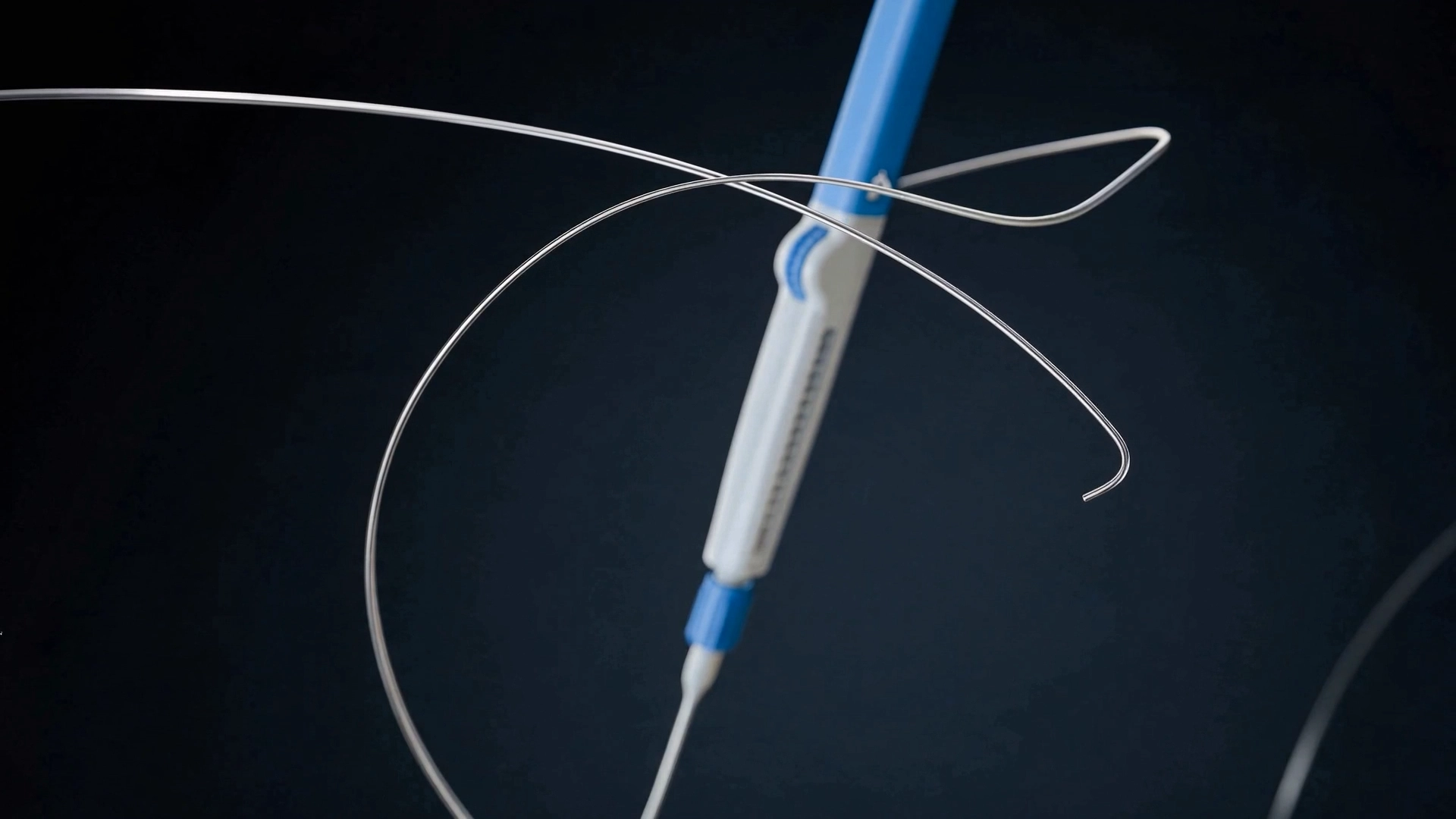
Albert 14 holds its shape, takes the turn on its own, and is driven entirely from the handle. Go anywhere, torque anywhere, rotate anywhere.
That is what a robotic platform needs from a guidewire: predictable shaping and controlled tip rotation, available to a motor rather than to a hand.
- 1. Dobrocky T, Lee H, Nicholson P, et al. When two is better than one: the buddy-wire technique in flow-diversion procedures. Clin Neuroradiol. 2022;32(2):491-498. doi:10.1007/s00062-021-01053-x
See how the tip steers.
Request a technical brief, schedule a clinical consultation, or discuss co-development.