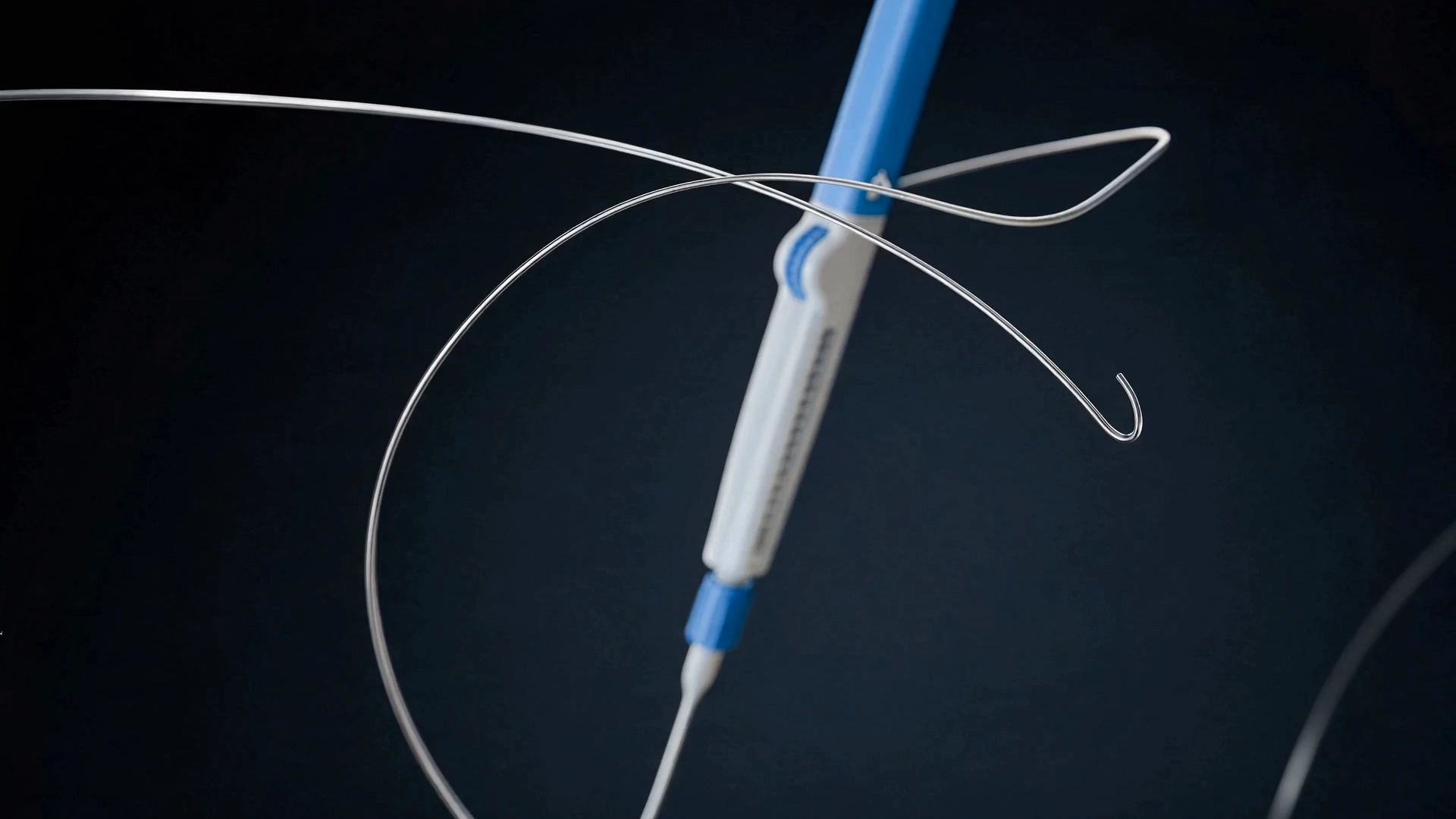
First in the world with Isolated Tip Torque™.
Torque the whole wire exactly as you do today, all the way to its limit. Then use the handle to switch to isolated tip control, rotating the tip alone through a full 360° - one step beyond where torque stops.
Access is the #1 driver of unexpected costs.
Reaching further into the brain means crossing more tortuous anatomy, which is where a conventional guidewire stops turning. Past that point the procedure stops and restarts rather than continuing. Three things happen there, and every one of them is billed.
Wire reshaping and replacement
Delays first-pass reperfusion, increases device passes, and raises the risk of failed recanalization, driving longer procedures and higher consumable costs.
Assistive tools
Balloon guides, intermediate catheters, and tri-axial systems are brought in to navigate sharp turns and hold stability, and serve as a bailout.
Prolonged navigation time
Delayed access to the target vessel lengthens cath lab time, fluoroscopy, anesthesia, and staffing.
One wire that takes the turn on its own. Designed to eliminate all three.
Creating new possibilities, preparing the ground for the future.
Breaking the torque limit.
Steering a guidewire means rotating all of it, and torque has to travel two meters to get there. Through tortuous anatomy the shaft stores the twist instead of passing it on, until it stops turning altogether. Isolated Tip Torque sends a push down the shaft instead, and a mechanism at the far end turns that into deflection and a full 360° at the tip alone.
A robot has no hands.
Conventional wires are reshaped by hand mid-procedure, and when they will not take a turn the physician reaches for a second device to make them. Neither is available to a motor, which is what makes a purpose-built wire a prerequisite for endovascular robotics rather than an accessory.
Value for every stakeholder.
For Interventionalists
Deflection and rotation are changed at the lesion, in the vessel, without withdrawing the wire. The intent is to take bifurcations and severe tortuosity that a fixed tip cannot.
For Robotics Partners
A wire that has to be reshaped by hand, or forced round a turn by a second device, is not available to a motor. A wire that steers on its own is the prerequisite.
For Hospital Value Committees
Lower procedural overhead: less cath lab time, and fewer secondary devices opened because a wire will not take a turn.
Backed by innovation ecosystems.



See how the tip steers.
Request a technical brief, schedule a clinical consultation, or discuss co-development.